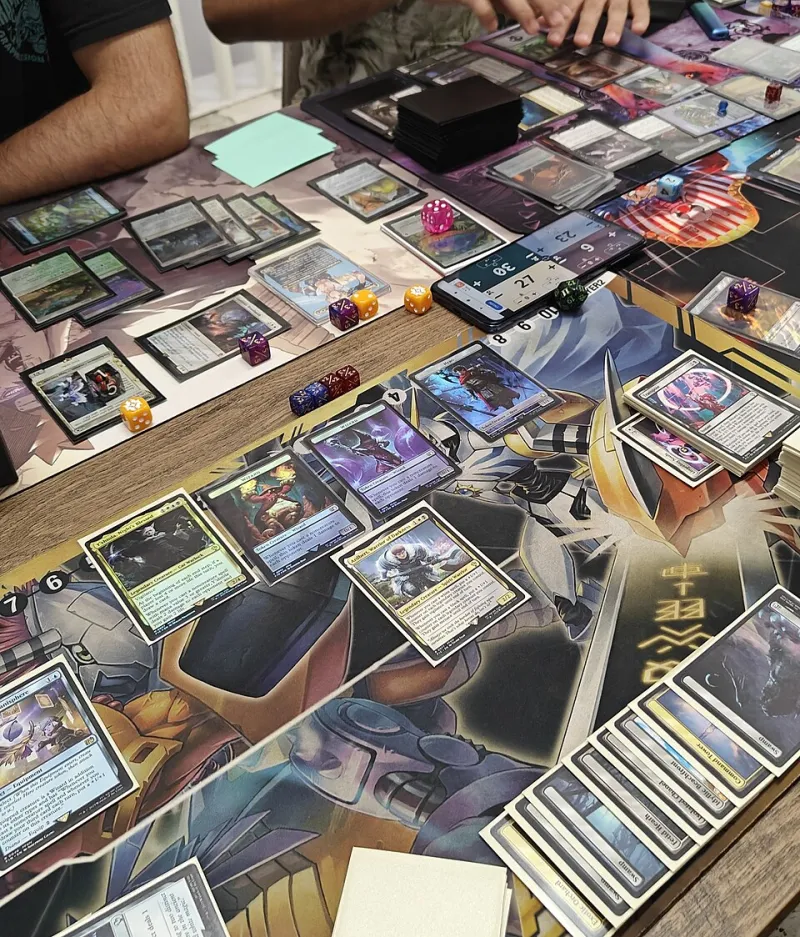
Nine Jobs of a Magic Night Host (And Why They Start Before the Doorbell)

Photo: Palickap, CC BY-SA 4.0, via Wikimedia Commons
The game store has a floor, a schedule, and a person behind the counter whose job is to keep things moving. Your living room has none of that. When a home Magic night fizzles, it is almost never because the decks were bad. It is because nobody was hosting.
Hosting is a real skill, and it is mostly invisible. Here is the job description, broken into nine parts, roughly in the order you will do them.
1. Send the Invite With the Details Attached
A group chat message that says 'Magic Saturday?' will get six emoji reactions and two actual commitments. Instead, name the format, the start time, the expected end time, the power level, and whether a deck is provided for anyone who needs one.
Vague invites attract vague attendance. Specific invites let people say yes.
2. Set a Hard Start Time and a Hard Food Time
Two clocks matter. The start time is when you shuffle, not when people arrive. If the invite says 6:30, the first game starts at 6:45 and everyone knows it, which trains people to show up close to on time.
The food clock is the one hosts forget. Nobody plays well hungry, and the hangry spiral around 8:15 has sunk more pods than any mana screw. Eat before the second round or eat before you start. Do not eat mid-round.
3. Seat for Chemistry, Not Convenience
You know your friends. The guy who explains every trigger in detail should not be seated next to the person who learned last month. The two competitive players who take losses personally should be at different tables if you have more than four.
If you run multiple pods, seat the least experienced players together with one patient teacher rather than scattering them. It is a kinder experience for everyone, and it makes the next invite easier to say yes to.
4. Cap the Pod Size and Know Your Table Math
Four is the default for Commander, but four is also the maximum number of people who can comfortably watch one board state develop. If eight people show up, split into two tables and rotate between rounds. Do not try to run a six-player free-for-all and then act surprised when it takes two hours and ends in a stalemate.
Also: table space. Two playmats side by side need about six feet. Measure your table before you promise a five-player game.
5. Talk About Power Level Before Decks Come Out
This is the host's most valuable contribution and the one most people skip because it feels awkward. It is not awkward if you make it routine.
Try this: everyone names their deck and one sentence about what it does, before anyone shuffles. 'Budget tokens, no infinite combos.' 'Midrange value, one two-card combo, it comes online around turn seven.' That is enough information for the table to calibrate.
If someone clearly brought a much stronger deck, the host's job is to name it kindly and offer an adjustment, not to let three people quietly get steamrolled for ninety minutes.
6. Build a Pacing Toolbox
Games have natural lengths. Decks that take twenty-minute turns and games with no clock are a mismatch for a weeknight. Keep a few tools handy:
- A turn timer or a friendly nudge. Not a chess clock — just an agreement that if you are tutoring for five minutes, the table gets to keep talking.
- A last-game call. Announce at a set time that the current game is the final one. It gives people permission to leave without an awkward goodbye.
- Background music at low volume. It fills dead air and quietly signals that the room has a host.
7. Have a Graceful Exit for the Mismatch
Someone's deck is doing nothing. Someone else's is doing everything. The host has two moves: offer a deck swap for the next game, or shorten the current game by encouraging a concession once the outcome is obvious.
Neither is rude when it is framed as a group norm. 'When it is clearly over, we shuffle up' is a house rule that saves an hour a night.
8. Give the Non-Player a Job
The friend who came to hang out but does not want to play is not a problem to solve. Hand them the snack table, the music, or the role of official photographer. People who feel useful come back and often end up playing later.
9. End on Time and Follow Up
When you said 10 p.m., end at 10 p.m. Overshooting the promised end time is the fastest way to lose the friend with a Saturday morning obligation.
The next day, send one message. Not a survey — just a note about what was fun. That message is the seed of the next invite, and it takes thirty seconds.
What the Host Is Actually Buying
The game store sells you a table and a schedule. At home, you are the schedule. You are the floor and the counter and the person who notices that somebody has been quiet for two rounds.
Do that well, and your Tuesday night becomes the thing people plan their week around. It is not about having the best decks at the table. It is about being the reason the table exists.